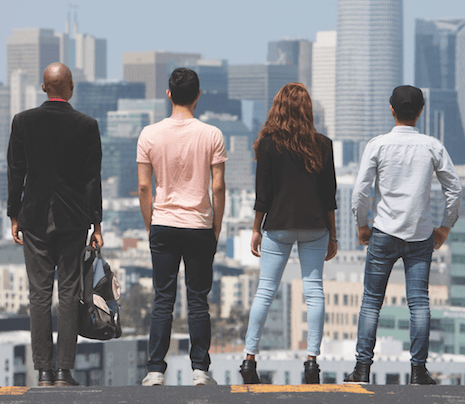
UNSETTLED is a film depicting the struggles of LGBT refugees as they arrive in the United States. For many, being a part of the LGBT community is a dangerous thing in their home countries. The stories told in this film demonstrate the bravery of these people as they leave everything behind to live in a country where they are accepted for who they are.
This film examines the stories of four people. Subhi, a gay man from Syria, fled his country to escape Islamic extremism and his homophobic family. He arrived in San Francisco at his sponsor’s house, ready to begin a new life for himself. Subhi began speaking out about homophobia in the Middle East, and eventually presented at the United Nations. He went on to gain popularity and is a well-known activist for LGBT rights.
Junior, a gender non-conforming person from the Congo, had escaped their community due to homophobia and violence. Junior came from a religious family of pastors that did not approve of their lifestyle. They had been seeking refuge in South Africa, and when they started to experience violence there, Junior decided to apply for asylum in the United States. Junior had a much different experience than Subhi upon arrival in the US. They were forced to move houses every month, as an affordable housing option was not presented to them. After many failed relationships and attempts to secure a home, Junior finally found a place to live. They began school at a community college, secured a job, and was on their way to beginning a new life in America.
The stories of Cheyenne and Mari, a lesbian couple from Angola, were also intriguing. After facing brutal violence and harassment in their home country, the couple fled to the US. They arrived on tourist visas but planned to seek asylum. Subhi and Junior had both applied in their home countries for asylum and were granted approval before arriving. Cheyenne and Mari’s story shines a light on the process of being granted asylum. After a long process, they were thankfully granted asylum. They both secured jobs and were married, something they could have never done in Angola.
One theme I found this film displays exceptionally was the diversity among people of the LGBT community. Each story portrayed individuals identifying within different realms of homosexuality. Each faced similar struggles in their home countries but did not have the same experiences upon integrating into American society. Subhi, an attractive gay man, seemed to have the smoothest transition into life in the US, whereas Junior, a non-conforming person had the most difficulty. Cheyenne and Mari were subjects of more discrimination within the US than Junior and Subhi.
Subhi’s transition into American society was a result of androcentrism, a term used to describe male dominance in society. Johnathan Wynn’s ideas surrounding androcentrism accurately depicts the transition of Subhi,
“Pierre Bourdieu writes of symbolic violence in his book Masculine Domination, describing a kind of invisible and pervasive form of power that is masked in the ‘everyday’ things that we do. Gender and sexuality are informed by our everyday institutions (e.g., the family, education, the media), and naturalize male domination.” (Wynn, Masculinity so Fragile).
Subhi was able to establish connections within the community and find employment, because of his identity. These connections provided him with the opportunity to speak at the United Nations, gaining fame and power from doing so. His attractive looks and charm also played a role in his journey. A society dominated by male superiority worked in Subhi’s favour, even though he identified as gay. Subhi did not have an easy journey in starting his new life, however he was provided with more opportunities and resources than others displayed in this film.
A major factor in Junior’s struggle to find adequate housing, was the fact they are HIV positive. After bouncing around countless apartments, hosted by people looking to support individuals seeking asylum, they were forced into a homeless shelter. People looking to support Junior eventually asked him to leave, because of their disease. The experience Junior had was a result of ableism. If Junior were not HIV positive, they could have expedited the process of finding their own place to live. Instead, they were more focused on where they would go when the month ended, and their sponsors no longer allowed them to stay in their home. Junior’s disease labels them as someone non-able bodied in the eyes of the sponsor. They require no physical accommodations; however, they carry a contagious disease. Western society labels those who are considered disabled as lower in society. Rosemarie Garland-Thompson explains the nature of those labeled disabled in the eyes of society, “Rather, disability is a culturally fabricated narrative of the body, similar to what we understand as the fictions of race and gender” (Garland-Thompson 259). Living with HIV is possible, and Junior’s sponsors should take the necessary precautions in accommodating them. Requiring them to leave after a month’s stay slowed their process in successfully starting a new life.
Cheyenne and Mari’s challenge were their national status within the United States. The couple entered the country as tourists, as they had not been granted refugee or asylum status. According to the Collins dictionary, national status is defined as “the status of someone as regarding their citizenship of a country” (Collins Dictionary). The process of being granted asylum is long and daunting. Cheyenne and Mari eventually ran out of money while in the process of filing their request. Thankfully they had a sponsor to help them during this time. A statistic shown in the film read that “Nearly 70% of asylum claims are denied by Homeland Security”. Near the end of the film, as they arrived at the Department of Homeland Security, a large group of people were seen who were also seeking asylum. Families with young children were shown who were not granted asylum, forcing them to return to their home country. In the end, Cheyenne and Mari had reasonable grounds in the eyes of the government to be granted asylum. Now that they have acquired the proper national status, they have the freedom to successfully start their lives.
UNSETTLED provides an intersectional viewpoint on the various issues LGBT asylum seekers face upon arriving in the US. Each person in this film had to overcome adversity to achieve what they came to the US for. Hearing the stories about the reality of LGBT violence in foreign countries provides a new outlook on asylum seekers and the stories they carry with them.
Works Cited
Wynn, Johnathan. “Masculinity so Fragile.” Everyday Sociology Blog, 16 Mar. 2016, www.everydaysociologyblog.com/2016/03/masculinity-so-fragile.html.
Garland-Thompson, Rosemarie. “Integrating Disability, Transforming Feminist Theory.”The Disability Studies Reader, 2nd ed. Davis, Lennard. New York& London: Routledge. 2006. 259
“National Status.” Collins Dictionary.com. 2020.https://www.collinsdictionary.com/dictionary/english/national-status(February 11, 2020)

 Find A Festival, Be Inspired